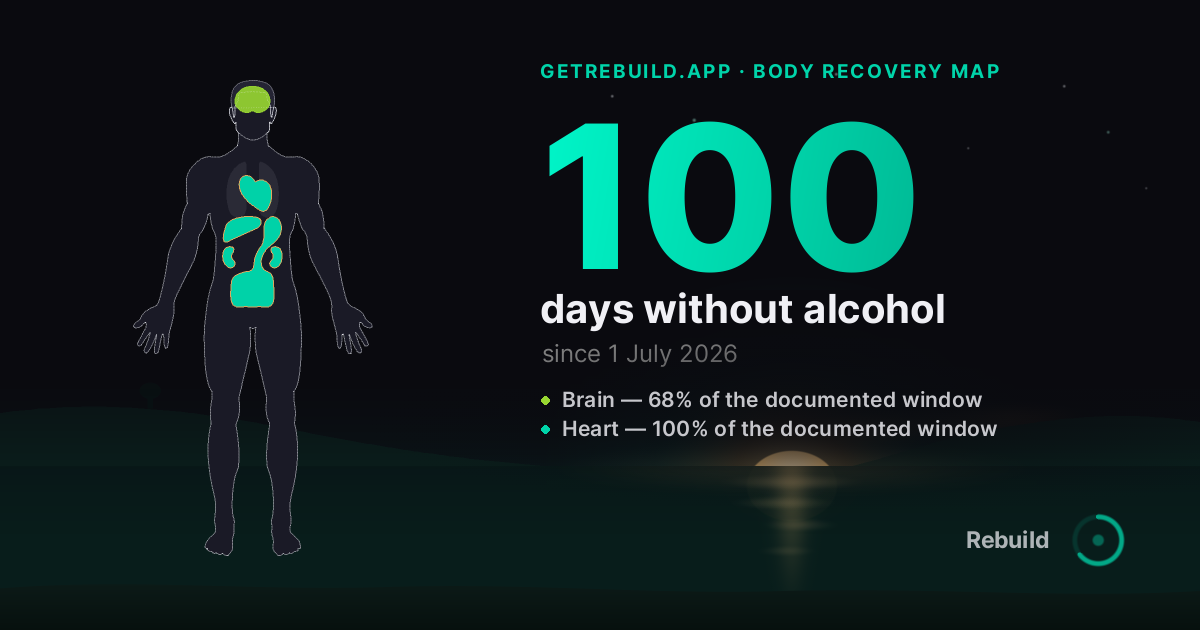
Brain
68%of the documented window
Measured by day 45
Six weeks of abstinence is enough to see some brain-volume recovery, but not volumes equal to healthy controls (Zahr & Pfefferbaum 2017).
Next measured change
At about seven months, two regions that had been smaller — the anterior cingulate and dorsolateral prefrontal cortex — were level with the control group; the hippocampus was still smaller. One study, 36 people, mostly men (Zou, Durazzo & Meyerhoff 2018).
Day 210 · January 27, 2027
The cohorts were dependent, treatment-seeking and mostly men. This window does not transfer to a moderate drinker cutting back.
Who was measured: dependent, treatment-seeking drinkers, mostly men.
Sources
- Alcohol Withdrawal Syndrome — StatPearls, NCBI Bookshelf (Canver, Newman, Gomez; Feb 2024)
- Alcohol withdrawal — MedlinePlus, US National Library of Medicine
- Changes in anxiety among abstinent male alcoholics — Journal of Studies on Alcohol, 1991 (PubMed)
- Rapid partial regeneration of brain volume during the first 14 days of abstinence from alcohol — Alcoholism: Clinical and Experimental Research, 2013 (PubMed)
- Alcohol's Effects on Brain and Behavior — Alcohol Research & Health, 2010 (NIAAA journal, PMC)
- Alcohol's Effects on the Brain: Neuroimaging Results in Humans and Animal Models — Alcohol Research: Current Reviews, 2017 (NIAAA journal, PMC)
- Regional Brain Volume Changes in Alcohol-Dependent Individuals During Short-Term and Long-Term Abstinence — Alcoholism: Clinical and Experimental Research, 2018 (PMC)
Heart and circulation
100%of the documented window
Measured by day 90
In heavy drinkers, blood pressure falls in proportion to the cut and the fall is sustained rather than progressive; at two drinks a day or fewer there was no significant change (Roerecke 2017).
Window complete
The last measured point in this window is day 90. Nothing later has been measured.
You said a few a week: the blood-pressure change in this window is not expected at two drinks a day or fewer (Roerecke 2017).
The blood-pressure findings come from heavy drinkers.
Who was measured: heavy drinkers.
Sources
Liver
100%of the documented window
Measured by day 90
Red-cell size (MCV), the slowest of the blood markers, normalises over two to four months (Jastrzębska 2023).
Window complete
The last measured point in this window is day 90. Nothing later has been measured.
These are blood markers, not liver tissue. Whether the tissue recovers depends on how far any damage had gone — that is a doctor's measurement, not a date's.
Who was measured: heavy drinkers.
Sources
Gut
100%of the documented window
Measured by day 19
After 19 days without alcohol, gut permeability in the dependent drinkers who had raised it came down to the control group's level; the gut bacteria were still disturbed (Leclercq 2014).
Window complete
The last measured point in this window is day 19. Nothing later has been measured.
Nothing about the gut has been measured beyond three weeks after quitting, so the window closes there. Nothing here says the gut bacteria have recovered.
Who was measured: dependent, treatment-seeking drinkers, mostly men.
Sources
Kidneys and fluid balance
100%of the documented window
Measured by day 1
Alcohol's effect on urine output is transient and does not cause appreciable fluid loss, so fluid balance returns within the first day (US Institute of Medicine 2005, via Polhuis 2017).
Window complete
The last measured point in this window is day 1. Nothing later has been measured.
Nothing about the kidneys is measured after the first day, so this window is one day long.
Who was measured: mixed cohorts.
Sources
Skin
Skin — no measured timeline
No study at any interval measures skin after a person stops drinking. The NHS lists better-looking skin as a benefit of drinking less, without a timeframe. The outline is drawn dotted and never scored.
Sources